By Mark Jarman with insights from Laura Ceballos
I call Bogota home now. Not as a line for the marketing brochure. I mean it in the literal sense that my life is here, my friends are here, and my understanding of what it means to work in Latin American agriculture runs through this country more than any other. I’ve worked across seven countries in this region, from the Argentine Pampas to the Ecuadorian coast, and I’m reasonably confident I’m not writing about the same Latin America that most people comment on from the outside. But Colombia is the one that gets under your skin in a way the others don’t. It amazes me, confuses me, and occasionally upsets me, sometimes within the same afternoon. It’s the most contradictory country I’ve ever spent serious time in, and that’s precisely what makes it so interesting.
No one wants to face Colombia in a tournament. Hard work, intensity, flair, genuine team spirit, and in Luis Diaz they have a player the world now recognises on sight. He grew up in Barrancas, La Guajira, a town most people couldn’t find on a map, came through Junior de Barranquilla, went to Porto, and is now at Bayern Munich. That arc from La Guajira to the Champions League is very Colombian. Talent emerging from conditions that would defeat most, making it without ever losing the thing that made it distinct. He hasn’t been smoothed into something generic. Then there’s the generation around him: Munoz at the back, all energy and industry, putting in the kind of shift that wins games in the margins. James Rodriguez scoring one of the great tournament goals against Uruguay in 2014. Valderrama’s hair and Higuita’s scorpion kick. Colombia has always had characters. The question, as Laura Ceballos at Agcenter puts it, is whether the system around the talent is built well enough to take them further.

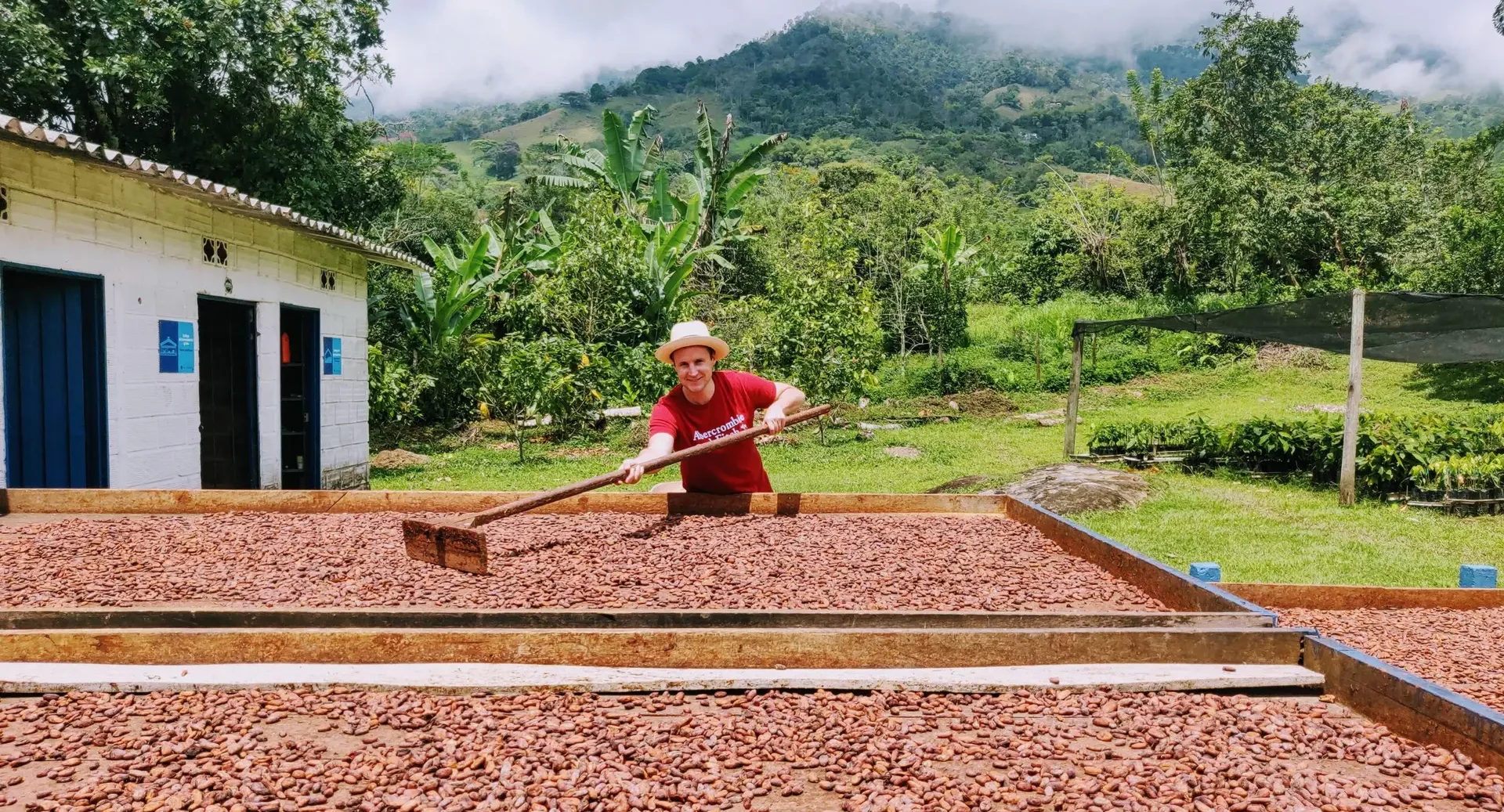
My first visit to Colombia was in 2015. I went from Oxfordshire directly to rural Tolima, to rice paddies near Saldana, working with Fedearroz, the national federation for rice growers. I had no idea about Latin America. My Spanish was limited. I arrived in a town where foreigners aren’t common, and the farmers and local staff didn’t make me feel like an outsider at all. They were open to learn, to share, to make you feel welcome. That experience shaped everything I’ve done here since. Colombia’s agriculture isn’t a backdrop. It’s a living system, and the people in it are its best feature.
I saw Colombia pass me in the street last month. A Tesla overtook a man pulling a cart and collecting cardboard. I keep coming back to that image, because it tells you more about this country’s contradictions than any economic report could. The innovation is real. Medellin went from being named the most dangerous city in the world in the 1990s to winning the Wall Street Journal’s most innovative city award. That arc, from narco capital to urban innovation model, is directly relevant to what Colombian agriculture is capable of. Transformation on that scale isn’t accidental. It takes sustained commitment and a willingness to bet on a different story when the old one is very loud.

Colombia has biological diversity that most countries can only dream about. You can eat a different fruit every day for three and a half years before you have to repeat yourself. That’s not a metaphor. The country’s varied altitude zones, from tropical coast to high-altitude paramo, produce year-round growing conditions of extraordinary range. Coffee is the global story: 841,354 hectares under cultivation, employing close to 730,000 people directly, and like Luis Diaz, it’s recognised on its own terms now rather than as a generic commodity. Colombian single-origin coffee doesn’t need to pretend to be something else. It came from humble origins, worked hard, and became itself.
Of the 40 million hectares assessed as suitable for agriculture in Colombia, only around 7 million are currently in productive use. The potential is enormous, but realising it means solving problems that have nothing to do with the quality of what Colombia can grow. A friend’s fruit business, moving organic produce from a rural department to Bogota for export, had to rely on public buses to get product to market. The cold chain barely exists beyond the main urban centres. A country that could be supplying premium perishables to the world is still trying to get them off the farm without losing them. That is the gap the sector is working against.

Laura Ceballos runs Agcenter and is one of the sharpest minds working on agricultural innovation in Colombia. She puts it directly: Colombia doesn’t have a technology problem. It has an articulation problem. The science exists. The startups exist. The producers exist. What’s missing is the connective tissue between them.
Innovation reaches Bogota and Medellin. It gets discussed, celebrated, piloted. It doesn’t automatically reach the Llanos, or Narino, or the Pacific coast, where a significant portion of Colombian agriculture actually happens. What Laura calls the Andean mindset, the tendency for decision-making and resources to concentrate in the capitals while agriculture exists somewhere else entirely, is a real constraint. Not a cultural flaw. A structural one, rooted in connectivity gaps, institutional under-reach, and the fact that 81.1% of Colombia’s agricultural producers are smallholders who own just 3.6% of the land.
The gap between what research institutions produce and what reaches the smallholder with three hectares in Cauca is still very wide. But here’s the point Agcenter presses that most international actors miss: the risk isn’t just that innovation doesn’t reach smallholders. It’s that innovation designed without them misses what they already know. Resilience, adaptability, territorial knowledge. These aren’t abstract concepts in Colombian agriculture. They’re daily survival mechanisms with real empirical value. The future of agrifood innovation here will depend on how well the ecosystem learns to build with producers, not just for them.

Most imported agtech models, when confronted with fragmented territories, difficult logistics and smallholder economies, fail not because Colombia rejected them but because they were never designed for here. The companies that last figured that out early, usually in a rural town they didn’t expect to visit, usually making friends they didn’t expect to keep.
Colombia just needs belief. Not the motivational poster version of it. The structural kind: the belief that infrastructure investment will come, that the articulation layer can be built, that the gap between a world-class innovation ecosystem in Medellin and a farming family in the Llanos is closeable rather than permanent. The Seleccion carries that possibility into every tournament and goes agonisingly close. The talent isn’t the question. No one doubts Luis Diaz. No one doubts that Colombian coffee is world-class or that the country’s biodiversity could anchor a bioeconomy of extraordinary richness.
The question is the system around the talent. That’s where the work is. And it’s not coincidentally the same question every international company entering this market has to answer about itself: are you here to engage with the system as it actually is, or are you here to talk about the system you wish existed? The ones who last in Colombia learned the difference early.
I’m one of those people. The rice paddies in Tolima in 2015 taught me more about this market than any report I’ve read since.
If you’re working in Colombian agriculture, agtech or food systems and want to connect, I’m based in Bogota and always interested in the conversation. Laura Ceballos at Agcenter is also worth knowing. Reach me at mark.jarman@agritierra.com.
Subscribe to get the latest posts sent to your email.
© 2025 Privacy — Terms
Subscribe now to keep reading and get access to the full archive.